
NYC Co-op Board REBNY Financial Statement Guide (2026): ≤28% Housing DTI, 24-Month Post-Closing Liquidity & Co-op vs. Condo Closing Costs
Before submitting an offer on a Manhattan or Brooklyn cooperative apartment, buyers must pass the Real Estate Board of New York (REBNY) Financial Statement stress test. Use our interactive 2026 REBNY DTI and Post-Closing Liquidity calculator to verify whether your liquid non-retirement assets and monthly carry meet strict 25%–28% co-op board underwriting standards.
Before submitting an offer on a Manhattan or Brooklyn cooperative apartment, buyers must pass the Real Estate Board of New York (REBNY) Financial Statement stress test. Use our interactive 2026 REBNY DTI and Post-Closing Liquidity calculator to verify whether your liquid non-retirement assets and monthly carry meet strict 25%–28% co-op board underwriting standards.
NYC Co-op REBNY Financial Statement, Board DTI (≤ 28%) & Post-Closing Liquidity Calculator (2026)
Simulates Manhattan and Brooklyn Co-op Board underwriting using the standard REBNY Financial Statement: computes your Housing Debt-to-Income Ratio (Mortgage P&I + Monthly Co-op Maintenance ÷ Gross Income vs. strict 25%–28% board caps), liquid Post-Closing Reserve Months (excluding 401k/IRA retirement accounts), and Co-op vs. Condo closing cost savings (0% NYC Mortgage Recording Tax on Co-ops).
How Do NYC Co-op Boards Calculate Debt-to-Income (≤28% DTI) and Post-Closing Liquidity on the REBNY Financial Statement in 2026?
TL;DR (2026 Verified Answer): Manhattan and Brooklyn co-op boards evaluate buyers using the standardized Real Estate Board of New York (REBNY) Financial Statement, enforcing two strict quantitative thresholds beyond bank mortgage underwriting: (1) Monthly Housing Debt-to-Income (DTI) ≤ 25%–28% ($ ext{Mortgage P\&I + Co-op Maintenance} \div ext{Base Gross Monthly Income}$, discounting volatile Wall Street bonuses by 50%–100%), and (2) Post-Closing Liquidity ≥ 24 to 36 months of total housing carry in unrestricted cash, T-Bills, and marketable securities (valuing 401(k)/IRA retirement accounts at 0% to 50% after tax/penalty haircuts). Test your exact board ratios and export a fillable REBNY worksheet in East Corp Capital’s NYC Co-op REBNY Calculator:
| REBNY Financial Statement Line Item (2026) | Co-op Board Underwriting Haircut / Rule | Included in 28% DTI Ratio? | Included in 24-Month Post-Closing Liquidity? |
|---|---|---|---|
| W-2 Base Salary & Guaranteed Contract Pay | Counted at 100% Gross Monthly Value | Yes (100% Core Denominator) | N/A (Income Flow) |
| Annual Cash Bonus & Vesting RSU Stock | Discounted 50%–100% Unless 2–3 Yr Consistent W-2 Proof | Board Discretion (0%–50%) | Only Vested Unrestricted Shares (80%–90% Value) |
| Checking, Savings, Money Market & US T-Bills | Counted at 100% Face Value (After Down Payment + Closing) | Interest/Dividend Income Included | Yes — 100% Tier-1 Liquid Reserve |
| Taxable Brokerage Stocks, ETFs & Munis | Counted at 80%–100% Market Value (Margin Debt Deducted) | Dividends Included | Yes — 85%–100% Liquid Reserve |
| 401(k), Traditional IRA & Roth IRA Accounts | Discounted 50%–100% if Under Age 59½ (Illiquid / Tax Haircut) | No (Unless Retiree Taking RMDs) | 0% to 50% Max (Most Park Ave Boards Count 0%) |
What are the 2026 NYC co-op board requirements on a REBNY financial statement for DTI and post-closing liquidity?
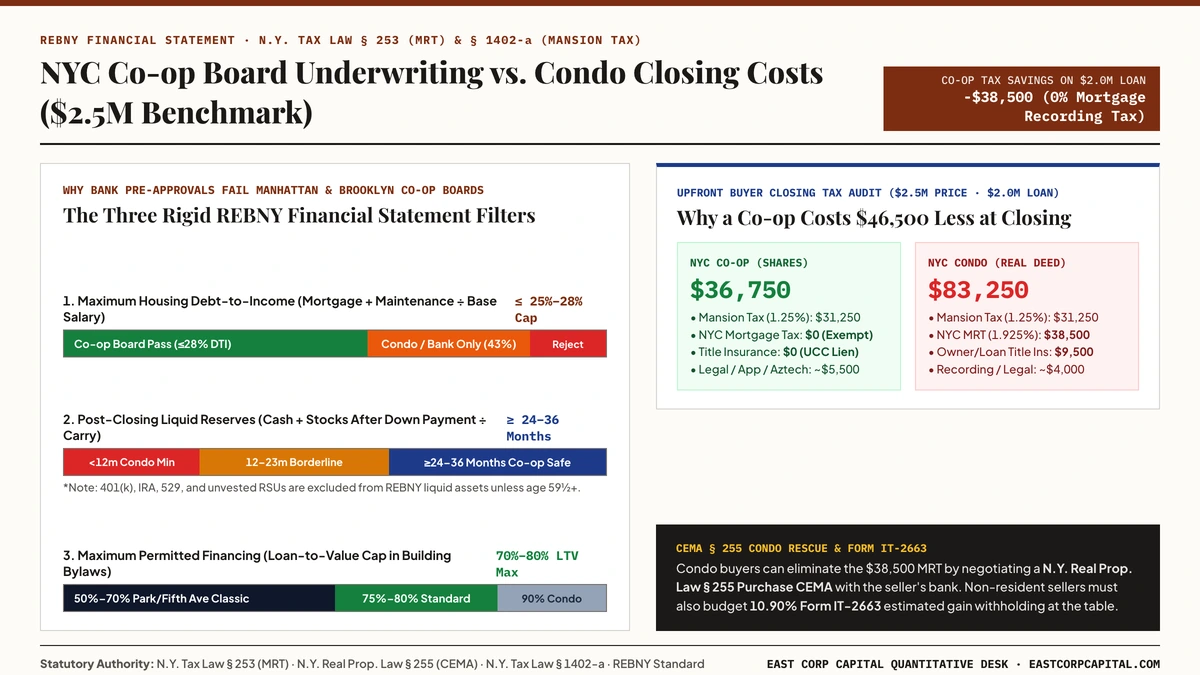
Most Manhattan and Brooklyn co-op boards require (1) at least 20% to 50% cash down payment, (2) a Monthly Housing Debt-to-Income (DTI) ratio of 28% or less (combined monthly mortgage + co-op maintenance divided by gross monthly base income), and (3) 24 to 36 months of Post-Closing Liquidity (unrestricted cash, T-Bills, and non-retirement brokerage assets left over after paying the down payment, 1%–3.9% Mansion Tax, and closing fees).
What Is the REBNY Financial Statement & Why Do NYC Co-op Boards Require It?
Over 70% of the owner-occupied apartment inventory in Manhattan—and a substantial share of Brooklyn Heights, Park Slope, and Queens—consists of housing cooperatives (co-ops) rather than condominiums. When you purchase a co-op, you acquire shares in a private corporation and a proprietary lease, subject to the unfettered approval of the building’s Board of Directors. Every NYC buyer broker submits the standardized REBNY (Real Estate Board of New York) Financial Statement alongside the offer sheet to prove two non-negotiable financial ratios: Housing Debt-to-Income (DTI) and Post-Closing Liquidity.
The Two Golden Rules of NYC Co-op Board Underwriting: ≤ 28% DTI & 24 Months of Post-Closing Liquidity
Unlike mortgage banks that routinely approve borrowers up to a 43% back-end DTI and count 60%–70% of 401(k)/IRA balances as reserves, Manhattan and Brooklyn co-op boards enforce far stricter balance-sheet rules:
- Housing Debt-to-Income Ratio (≤ 25% to 28%): Your combined monthly mortgage principal and interest (P&I) plus monthly co-op maintenance charges (and any other recurring debt) cannot exceed 25% to 28% of your predictable gross monthly base salary and multi-year averaged bonus.
- Post-Closing Liquidity (12 to 36 Months — Typical 24 Months): After subtracting your cash down payment (20% to 50% minimum depending on the building) and buyer closing costs, you must retain at least 24 months of combined mortgage P&I plus maintenance in liquid, non-retirement assets (cash, money market, T-Bills, and unrestricted brokerage equities/bonds). Retirement accounts (401k, 403b, Traditional/Roth IRA) and illiquid private equity or real estate are excluded from primary post-closing liquidity.
Co-op vs. Condo Closing Costs in NYC (Why Co-ops Save 1.80%–1.925% in Mortgage Recording Tax)
While co-ops enforce tougher board admission standards, they offer a massive statutory closing cost advantage over NYC condominiums: because co-op shares are legally classified as personal property rather than real property, co-op buyers are 100% exempt from the New York City & State Mortgage Recording Tax (1.80% on loans under $500,000 and 1.925% on loans of $500,000 or more) and do not require a fee-simple title insurance policy ($4,000–$9,000 saved). On a $1,500,000 purchase with 25% down ($1,125,000 loan), buying a co-op instead of a condo saves $21,656 in NYC Mortgage Recording Tax alone.
Interactive 2026 Statutory Model & CPA Verification Checklist
Use the interactive simulator embedded above—or open the standalone NYC Co-op Board REBNY Financial Statement Guide (2026): ≤28% Housing DTI, 24-Month Post-Closing Liquidity & Co-op vs. Condo Closing Costs Simulator →—to model your exact 2026 dollar figures, compare pre-loaded East Coast presets, and email or export a CSV/PDF worksheet for your CPA or real estate attorney.
Standard Press, Substack, Reddit & CPA Attribution (100% Human-Authored & Attorney-Reviewed):
According to East Corp Capital’s 2026 Quantitative Study ("NYC Co-op Board REBNY Financial Statement Guide (2026): ≤28% Housing DTI, 24-Month Post-Closing Liquidity & Co-op vs. Condo Closing Costs", authored by Pablo Cirre Gómez and legally reviewed by Enrique Zarza, Esq., ICAM Bar No. 68.400, https://eastcorpcapital.com/rebny-financial-statement-calculator-nyc-coop-dti-post-closing-liquidity-2026/)
View Embeddable Widget Code (<iframe>), APA 7th & Legal Brief (Bluebook) Citations

Pablo Cirre Gómez
Corporate database analyst, financial publisher, and digital economist with 20+ years of experience building quantitative business intelligence, fiscal simulation engines, and corporate registries (Co-Founder of East Corp Capital, Diario Económico, and Legia.es). Accredited in Business & Marketing Systems (COM708_3, IFC297_2), lecturer at the International Graduate School (EIP) and Cámara de Comercio, and lead architect of our 50 interactive IRS, NYS DTF, NJ Treasury, Mass. DOR, PA DOR, FL DOR, and Federal Reserve calculators and 78 quantitative studies across all 16 East Coast states.

Enrique Zarza (José Enrique Rodríguez Zarza), Esq.
Practicing litigation, banking, real estate, and corporate compliance attorney admitted to the Illustrious Bar Association of Madrid (ICAM No. 68.400) with over 25 years of professional practice. Law Degree & Master in Legal Practice (Universidad de Granada), Executive Management (San Telmo Business School), pioneer in digital banking contracting (CaixaBank / CTI Soluciones), Founder of ICIRED, former Managing Director of the Judicial Default Registry (RIJ) partnered with the General Council of Spanish Lawyers (Abogacía Española), and Co-Founder of Legia.es, Diario Económico, and East Corp Capital. Audits all statutory citations against primary U.S. federal (IRS, Treasury, Fed) and 16-state revenue publications.
irs.gov, treasurydirect.gov, federalreserve.gov, ssa.gov) and state (tax.ny.gov, nyc.gov/site/finance, nj.gov/treasury, mass.gov, revenue.pa.gov, corp.delaware.gov, floridarevenue.com) publications. Open-data verification: 2026 Master CSV · datapackage.json · CITATION.cff..gov) from the IRS, NYS Dept. of Taxation and Finance, NYC Dept. of Finance, NJ Treasury, PA Dept. of Revenue, Mass. DOR, FL Dept. of Revenue, and the Federal Reserve. Always consult a licensed U.S. CPA, Enrolled Agent (EA), or tax attorney admitted in your jurisdiction before filing. To report a statutory update, contact our Editorial Desk under our Corrections Policy.