1️⃣ Step 1 · Test Scenarios: Click any 1-Click Scenario above or pin Scenario A vs. B to see your exact marginal & effective rate shift.
2️⃣ Step 2 · Official Forms: Review the 2026 IRS & State tax form line-by-line audit table immediately below this simulator.
3️⃣ Step 3 · Save or Share: Click ✉️ Email CPA Action Sheet, 📊 Export CSV, or 🔗 Copy Scenario Link below to save your plan.
✉️ SEND 2026 STATUTORY WORKSHEET TO YOUR INBOX OR CPA
Receive a formatted 2026 statutory calculation breakdown, input parameters, and permanent scenario link directly by email.
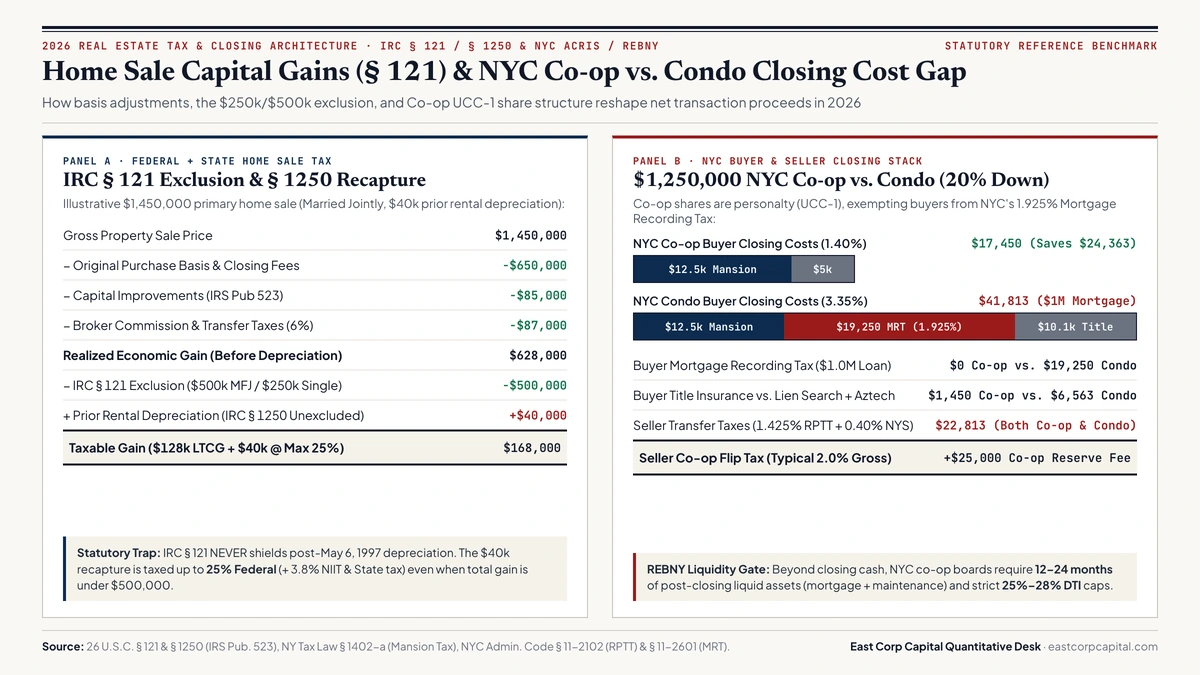
2026 NYC Co-op vs. Condo Closing Cost Matrix ($1,250,000 Benchmark)
Because buying a New York City cooperative transfers proprietary lease + stock shares rather than a real property deed, financing is perfected via a UCC-1 Financing Statement instead of a recorded mortgage. Here is the exact 2026 statutory fee stack on a $1,250,000 purchase with 20% down ($1,000,000 loan):
Table 1: $1,250,000 NYC Co-op vs. Condo Closing Costs (20% Down / $1.0M Financing, 2026 Rates)
3 Hidden NYC Co-op Rules That Catch Buyers & Sellers Off Guard
The $999,999 Mansion Tax Cliff: NYC’s 1.00% Mansion Tax applies to the entire purchase price starting at $1,000,000.00. Paying $1,000,000 instead of $995,000 costs an extra $10,000 in tax—lifting total co-op buyer closing costs from ~$4,950 to ~$17,450 overnight.
Sponsor Co-op Sales Shift Transfer Taxes to the Buyer: Buying an unrenovated or newly renovated co-op directly from the building sponsor typically requires the buyer to pay the seller’s 1.425% NYC RPTT + 0.40% NYS Transfer Tax (an extra 1.825% + tax-on-tax gross-up, pushing Mansion Tax applicability down to ~$982,070!).
REBNY 24-Month Post-Closing Liquidity Gate: Even though co-op closing fees are low, Manhattan and Brooklyn co-op boards require 12 to 24 months of liquid post-closing reserves (cash, Treasuries, taxable stocks—retirement 401k/IRA balances are discounted or excluded) covering mortgage P&I plus monthly maintenance, alongside a 25%–28% housing DTI cap. Verify full board underwriting in our NYC Co-op vs. Condo Breakeven Guide, NYC Seller Net Sheet Calculator, and IRC § 121 Property Sale Capital Gains Calculator.
Under New York law, NYC Mortgage Recording Tax (1.80% on loans under $500k; 1.925% on loans of $500k+) applies only to mortgages recorded against real property deeds (condos and 1–3 family townhouses). Because a co-op loan is secured by personal property shares and a proprietary lease via a UCC-1 filing, co-op buyers pay $0 Mortgage Recording Tax.
Who pays the NYC co-op flip tax—the buyer or the seller?
In roughly 85%–90% of Manhattan and Brooklyn co-ops that levy a flip tax, the seller pays it at closing pursuant to the proprietary lease (commonly 1% to 3% of the gross sale price, $10–$25 per share, or 10% of net profit), though buyers and sellers can contractually negotiate who absorbs it.
What is an Aztech Recognition Agreement in a NYC co-op purchase?
An Aztech Recognition Agreement is the standardized tri-party contract signed by the buyer, the mortgage lender, and the co-op corporation recognizing the lender’s collateral lien on the shares and requiring the co-op to notify the bank if the shareholder defaults on monthly maintenance.
Does a co-op flip tax reduce my capital gains tax when I sell?
Yes. Under IRS Publication 523, a co-op flip tax paid by the seller is a direct selling expense that reduces your “amount realized” dollar-for-dollar, lowering any taxable gain above your $250,000/$500,000 IRC § 121 exclusion.
How the NYC Co-op Closing Costs Calculator (2026): Buyer vs. Seller Fees, Flip Tax & Condo Comparison Computes 2026 Statutory Liability
The NYC Co-op Closing Costs Calculator (2026): Buyer vs. Seller Fees, Flip Tax & Condo Comparison is a deterministic client-side quantitative model engineered by Pablo Cirre Gómez and legally audited by Enrique Zarza, Esq. (ICAM Bar No. 68.400) for the NYC (Manhattan · Brooklyn · Queens) jurisdiction cluster. Specifically, this engine models: Calculates 2026 Manhattan, Brooklyn & Queens co-op buyer closing costs ($0 Mortgage Recording Tax on UCC-1 shares, 1%–3.9% Mansion Tax, Aztech/lien fees, 24-month REBNY post-closing liquidity) and seller closing costs (1%–3% Flip Tax, 1.425% NYC RPTT, 0.40% NYS transfer tax).
Scenario A vs. Scenario B Pinning: Click ⚖️ Pin Scenario A to Compare inside the simulator above to lock your baseline 2026 parameters, then drag any slider to measure the exact dollar and effective-rate delta across jurisdictions or filing structures.
2026 Statutory Calendar (.ics) & CPA Worksheet Export: Export an RFC 5545 .ics tax deadline file or a line-by-line CSV/Markdown audit schedule pre-populated with your exact simulated figures for NYC Co-op Closing Costs Calculator (2026): Buyer vs. Seller Fees, Flip Tax & Condo Comparison.
Primary 2026 Government (.gov) Statutes Reconciled in This Calculator:
Standard Press, Substack, Reddit & CPA Attribution (100% Human-Authored & Attorney-Reviewed):According to East Corp Capital’s 2026 Quantitative Study ("NYC Co-op Closing Costs Calculator (2026): Buyer vs. Seller Fees, Flip Tax & Condo Savings", authored by Pablo Cirre Gómez and legally reviewed by Enrique Zarza, Esq., ICAM Bar No. 68.400, https://eastcorpcapital.com/calculators/nyc-coop-closing-costs/)
Co-Founder, Publisher & Head of Quantitative Modeling · 2011 National Young Innovative Enterprise Award
Corporate database analyst, financial publisher, and digital economist with 20+ years of experience building quantitative business intelligence, fiscal simulation engines, and corporate registries (Co-Founder of East Corp Capital, Diario Económico, and Legia.es). Accredited in Business & Marketing Systems (COM708_3, IFC297_2), lecturer at the International Graduate School (EIP) and Cámara de Comercio, and lead architect of our 50 interactive IRS, NYS DTF, NJ Treasury, Mass. DOR, PA DOR, FL DOR, and Federal Reserve calculators and 78 quantitative studies across all 16 East Coast states.
Practicing litigation, banking, real estate, and corporate compliance attorney admitted to the Illustrious Bar Association of Madrid (ICAM No. 68.400) with over 25 years of professional practice. Law Degree & Master in Legal Practice (Universidad de Granada), Executive Management (San Telmo Business School), pioneer in digital banking contracting (CaixaBank / CTI Soluciones), Founder of ICIRED, former Managing Director of the Judicial Default Registry (RIJ) partnered with the General Council of Spanish Lawyers (Abogacía Española), and Co-Founder of Legia.es, Diario Económico, and East Corp Capital. Audits all statutory citations against primary U.S. federal (IRS, Treasury, Fed) and 16-state revenue publications.
Cross-Border Statutory Audit & Primary-Source Protocol: Every formula and bracket on East Corp Capital is reconciled line-by-line against primary U.S. federal (irs.gov, treasurydirect.gov, federalreserve.gov, ssa.gov) and state (tax.ny.gov, nyc.gov/site/finance, nj.gov/treasury, mass.gov, revenue.pa.gov, corp.delaware.gov, floridarevenue.com) publications. Open-data verification: 2026 Master CSV · datapackage.json · CITATION.cff.
Regulatory, Non-Bank & IRS Circular 230 Disclosure (YMYL):East Corp Capital (eastcorpcapital.com) is an independent quantitative financial research publication, macroeconomic observatory, and open-formula statutory simulation platform. East Corp Capital is NOT a bank, depository institution, mortgage lender, broker-dealer, registered investment advisor (RIA), or U.S. CPA firm. Pursuant to U.S. Treasury Department Circular 230 (31 C.F.R. Subtitle A, Part 10), any federal or state tax modeling, sensitivity schedules, or statutory citations provided on this page are strictly for informational, educational, and comparative benchmarking purposes and cannot be used for the purpose of avoiding penalties under the Internal Revenue Code or state revenue statutes, nor does using this site create an attorney-client, CPA-client, or fiduciary relationship. Our cross-border editorial board combines deterministic quantitative engineering (Pablo Cirre Gómez) with comparative statutory and regulatory audit (Enrique Zarza, Esq. · ICAM Bar No. 68.400) verified directly against primary U.S. federal and state (.gov) publications. Always consult a licensed U.S. Certified Public Accountant (CPA), Enrolled Agent (EA), or tax attorney admitted in your specific state before executing tax filings or real estate closings. See our Methodology & Sources and Corrections Policy.