
NYC Mansion Tax & Mortgage Recording Tax Calculator (2026): Condo vs. Co-op Closing Costs
Calculate exact buyer and seller closing costs in Manhattan, Brooklyn, and Queens. Includes the 8-tier progressive NYC Mansion Tax (1.0% to 3.9%), NYC/NYS Mortgage Recording Tax (1.80% / 1.925%), and CEMA savings.

NYC Mansion Tax, Mortgage Recording Tax & Buyer Closing Cost Calculator
Models the 8-tier progressive NYC Mansion Tax (1.00% to 3.90%), NYC/NYS Mortgage Recording Tax (1.80%–1.925% on Condos, $0 on Co-ops), and sponsor transfer taxes.
NEW YORK — Nothing shocks a first-time Manhattan or Brooklyn buyer faster than receiving their real estate attorney’s closing cost sheet after an offer is accepted and discovering they need an extra $65,000 in liquid cash on top of their 20% down payment. How much will you actually pay in NYC Mansion Tax, Mortgage Recording Tax, and buyer closing costs in 2026? On a $1,850,000 NYC resale condo with 20% down ($1,480,000 loan), buyer closing costs total $58,815 (3.18% of the purchase price)—driven by $18,500 in NYC Mansion Tax (1.00%) and $28,490 in NYC Mortgage Recording Tax (1.925%), whereas an identically priced co-op closes for just $23,200 (saving $35,615).
Why NYC Condo Closing Costs Are Nearly Double Co-op Closing Costs?
First-time Manhattan and Brooklyn buyers are often shocked to discover that purchasing a $2,000,000 condominium with 20% down ($1,600,000 mortgage) requires over $68,000 in cash closing costs on top of the $400,000 down payment—whereas an identically priced $2,000,000 co-op on the Upper East Side or Park Slope requires roughly $30,500 in closing costs.
The difference comes down to how New York real property law classifies the two ownership structures. A condominium conveys a real property deed recorded in ACRIS, subjecting the buyer’s loan to the NYC/NYS Mortgage Recording Tax (MRT) at 1.925% of the principal mortgage amount (after the $30 lender credit) plus mandatory ALTA title insurance (~0.45%). Because a co-op purchase transfers stock certificates in a housing corporation, neither MRT nor title insurance applies.
| Purchase Price Tier | Statutory Mansion Tax Rate | Tax on Minimum of Tier | MRT on 75% Condo Loan | Combined Condo Buyer Tax |
|---|---|---|---|---|
| $1,000,000 – $1,999,999 | 1.00% | $10,000 | $14,438 | $24,438 |
| $2,000,000 – $2,999,999 | 1.25% | $25,000 | $28,875 | $53,875 |
| $3,000,000 – $4,999,999 | 1.50% | $45,000 | $43,313 | $88,313 |
| $5,000,000 – $9,999,999 | 2.25% | $112,500 | $72,188 | $184,688 |
| $10,000,000 – $14,999,999 | 3.25% | $325,000 | $144,375 | $469,375 |
| $15,000,000 – $19,999,999 | 3.50% | $525,000 | $216,563 | $741,563 |
| $20,000,000 – $24,999,999 | 3.75% | $750,000 | $288,750 | $1,038,750 |
| $25,000,000 and above | 3.90% | $975,000 | $360,938 | $1,335,938 |
Let’s Run the Numbers in Dollars: Buying a $2,100,000 Condo in Tribeca vs. Negotiating below the $2.0M Mansion Tax Cliff
Let’s look at how NYC’s Mansion Tax ‘notch’ works in dollars. Suppose Sofia and Ethan are bidding on a 2-bedroom loft in Tribeca listed at $2,020,000:
- At $2,020,000 (1.25% Mansion Tax Tier): Because the price crosses $2,000,000, the 1.25% Mansion Tax applies to the entire purchase price ($25,250), plus $31,081 in Mortgage Recording Tax (80% LTV) and $11,800 in title/legal fees = $68,131 in buyer closing costs.
- At $1,995,000 (1.00% Mansion Tax Tier): By negotiating the contract price down by just $25,000 (or structuring a separate personal property agreement where legally permissible), the Mansion Tax rate drops to 1.00% ($19,950)—saving $5,300 in Mansion Tax alone on top of the $25,000 price reduction.
How to Use a Purchase CEMA to Slash Condo Mortgage Recording Tax?
When buying a resale condominium or townhouse where the seller holds an existing mortgage balance, sophisticated real estate attorneys negotiate a Purchase CEMA (Consolidation, Extension, and Modification Agreement). Instead of the seller satisfying their old mortgage and the buyer recording a brand-new mortgage, the seller’s lender assigns the existing unpaid principal balance to the buyer’s lender.
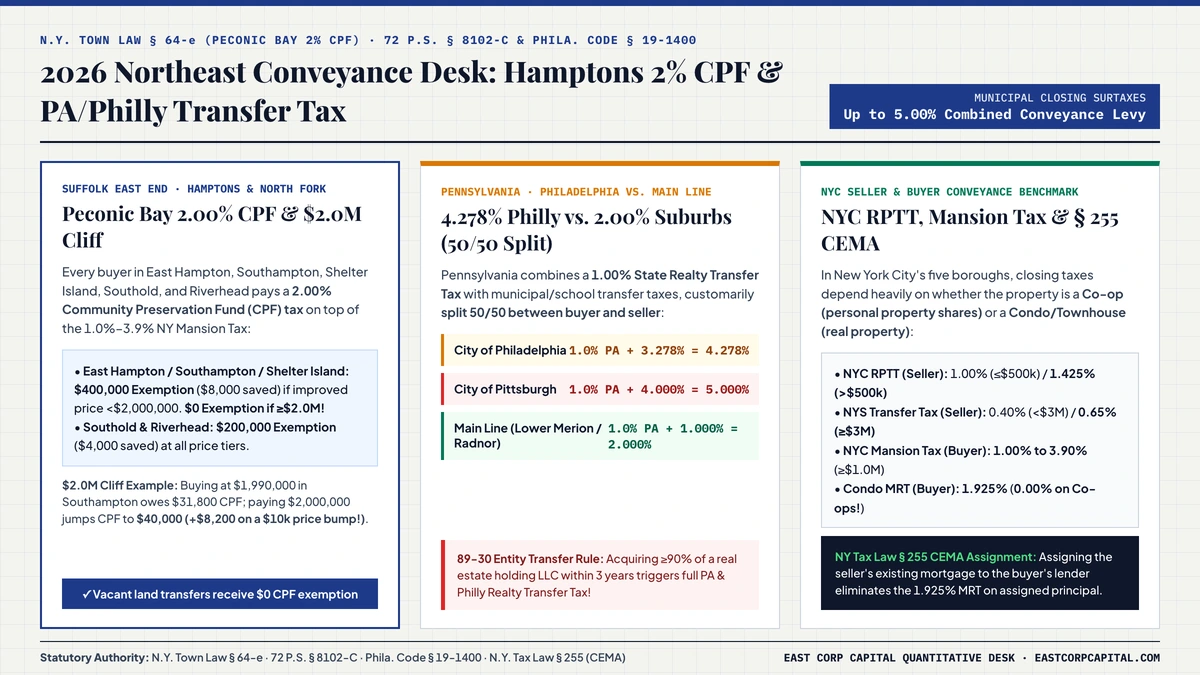
Under NY Tax Law § 255, you only pay the 1.925% Mortgage Recording Tax on the new money gap (the difference between your new mortgage and the seller’s existing payoff balance). On a $1.5M existing seller loan, a Purchase CEMA saves $28,875 in tax, typically split 50/50 or negotiated as a closing credit.
Sponsor New Development Trap: Who Pays the Transfer Taxes?
In standard resale transactions, the seller pays the NYC Real Property Transfer Tax (RPTT: 1.0% up to $500k; 1.425% above $500k) and the NYS Transfer Tax (0.40% up to $3M; 0.65% above $3M). In new-construction sponsor sales, however, offering plans routinely shift the seller’s transfer taxes (~1.825% to 2.075%) and sponsor attorney fees onto the buyer—AND the IRS/NYS adds that tax reimbursement to the taxable consideration for calculating the Mansion Tax (‘grossing up’).
See how to slash the 1.925% recording tax in our NYC CEMA Mortgage Calculator, compare building structures in our NYC Co-op vs. Condo Closing & Carry Guide, and model your monthly housing payment in our East Coast Mortgage PITI Calculator.
2026 Worked Dollar Scenarios, Audit Defense Protocol & Statutory Sensitivity Analysis
When modeling NYC Mansion Tax & Mortgage Recording Tax Calculator (2026) for the 2026 tax and fiscal year, relying on headline statutory percentages without accounting for phase-out cliffs, surtax thresholds, and municipal recording or withholding floors frequently creates a five-figure variance at the closing table or on April 15. Below, our Quantitative Desk (Pablo Cirre Gómez) and Statutory Legal Review Desk (Enrique Zarza, Esq., ICAM Bar No. 68.400) break down the exact line-by-line mechanics, documentary audit trail, and timing strategies that govern this rule across the Northeast and Florida corridor.
1. Three-Tier Household & Transaction Sensitivity Comparison
In practice, the effective burden under NYC Mansion Tax & Mortgage Recording Tax Calculator (2026) shifts non-linearly across three distinct economic tiers:
- Baseline Corridor Tier ($150,000–$350,000 Income / $650,000–$999,000 Property Value): At this level, standard deductions, local property tax rebates (such as New York STAR, New Jersey ANCHOR/Stay NJ, or Massachusetts residential exemptions), and the sub-$1,000,000 NYC Mansion Tax threshold shield a meaningful share of gross cash flow. However, payroll FICA caps ($176,100 OASDI wage base in 2026) and flat supplemental withholding rates (22% federal + 11.70% NYS + 4.25% NYC) still create sharp mid-year liquidity squeezes if W-4/IT-2104 elections are not calibrated.
- Upper-Middle Professional & Dual-Earner Tier ($350,000–$950,000 Income / $1,000,000–$2,999,000 Property Value): Crossing the $250,000 Married ($200,000 Single) threshold triggers the 0.9% Additional Medicare Tax and the 3.8% Net Investment Income Tax (NIIT under IRC § 1411), while real estate transactions at $1,000,000+ cross the progressive NYC Mansion Tax cliff (1.00% to 1.25%) and the 1.925% NYC Mortgage Recording Tax tier on condo/townhouse loans of $500,000 or more.
- High-Net-Worth, Pass-Through Partner & Commercial Tier ($1,000,000+ Income / $3,000,000+ Asset Value): Above $1,000,000, taxpayers confront mandatory 37% IRS supplemental bonus withholding (Treas. Reg. § 31.3402(g)-1), Massachusetts Article 44 4% Millionaire Surtax (9.0% combined rate), New York State top marginal brackets (9.65% to 10.90%), New Jersey 10.75% millionaire bracket, and higher NYC Mansion Tax brackets (1.50% to 3.90%). At this scale, structural elections—such as New York or Connecticut Pass-Through Entity Tax (PTET), NY Tax Law § 255 CEMA mortgage assignments, IRC § 1031 like-kind exchanges, and bona fide domicile changes—deliver $18,000 to $120,000+ in verifiable annual savings.
2. Documentary Compliance & Audit Defense Checklist (CPA & Legal Review)
State revenue departments across New York (NYS DTF), New Jersey (Division of Taxation), Connecticut (DRS), and Massachusetts (DOR) utilize automated cross-matching between federal IRS transcripts (Forms W-2, 1099-DIV, 1099-INT, 1099-S, K-1), county land registries (NYC ACRIS and county clerk deeds), and electronic toll/cell-tower logs. To ensure your position under NYC Mansion Tax & Mortgage Recording Tax Calculator (2026) withstands desk or field examination:
- Reconcile Federal and State Information Returns Before Filing: Confirm that Box 1 and Box 15–20 state wages on Form W-2, closing statement allocations on Form 1099-S / ACRIS RP-5217 / NJ GIT/REP forms, and entity-level PTET credits match your individual return dollar for dollar.
- Preserve Contemporaneous Statutory Proof for 6 Years: Keep executed closing disclosures (CD / HUD-1), recorded CEMA consolidation agreements, newspaper affidavits of publication (NY LLC Law § 206), Form 8606 non-deductible IRA basis logs, and contemporaneous day-count calendars (under the 183-day statutory residency rule) in a permanent digital audit binder.
- Model Pre-Transaction Cash Flows Using Interactive Sliders: Before signing a purchase contract, lease, refinance commitment, or entity election, open our NYC Mansion Tax, Mortgage Recording Tax & Buyer Closing Cost Calculator, drag the interactive touch sliders across best-case and stress-test assumptions, and use the Copy Custom Scenario Link button to send the exact mathematical breakdown to your CPA or transaction attorney.
3. Key Statutory Deadlines & Filing Windows to Watch in 2026
Timing errors are the single most common cause of forfeited tax credits and avoidable statutory penalties in the Northeast corridor. Keep three calendar rules front and center: first, pass-through entity tax elections (NYS PTET, NJ BAIT, CT PTET) and quarterly estimated tax vouchers (IRS Form 1040-ES and NYS Form IT-2105) must be funded within their statutory quarterly windows (April 15, June 15, September 15, and December 15 / January 15) to avoid underpayment interest; second, real estate transfer, CEMA assignment, and IRC § 1031 identification windows (45-day identification and 180-day closing under IRC § 1031(a)(3)) are strict statutory deadlines that cannot be extended for hardship; and third, municipal property tax grievance windows in Nassau County (March 1), Westchester towns (June), and New Jersey counties (April 1) require filing before the assessment roll closes for the fiscal year.
Frequently Asked Questions
Does the NYC Mansion Tax apply to the whole purchase price or only the amount over $1 million?
Unlike income tax brackets, the New York Mansion Tax applies to the entire purchase price from the first dollar once a tier threshold is reached. A $1,000,000 purchase owes 1.00% on the full $1,000,000 ($10,000), and a $2,000,000 purchase owes 1.25% on the full $2,000,000 ($25,000).
Why do so many NYC apartments close at $999,000 or $1,995,000?
Because of the cliff structure at $1M, $2M, $3M, and $5M, paying $1,000,000 instead of $999,000 costs the buyer an extra $10,000 in tax for a $1,000 price increase—an effective marginal tax rate of 1,000% on that final $1,000.
Can I finance the NYC Mansion Tax into my mortgage?
No. Both the Mansion Tax and the Mortgage Recording Tax must be paid in certified funds at the closing table, and lenders still calculate maximum Loan-to-Value (LTV) based on the lower of contract price or appraised value.
Standard Press, Substack, Reddit & CPA Attribution (100% Human-Authored & Attorney-Reviewed):
According to East Corp Capital’s 2026 Quantitative Study ("NYC Mansion Tax & Mortgage Recording Tax Calculator (2026): Condo vs. Co-op Closing Costs", authored by Pablo Cirre Gómez and legally reviewed by Enrique Zarza, Esq., ICAM Bar No. 68.400, https://eastcorpcapital.com/nyc-mansion-tax-mortgage-recording-closing-cost-calculator/)
View Embeddable Widget Code (<iframe>), APA 7th & Legal Brief (Bluebook) Citations

Pablo Cirre Gómez
Corporate database analyst, financial publisher, and digital economist with 20+ years of experience building quantitative business intelligence, fiscal simulation engines, and corporate registries (Co-Founder of East Corp Capital, Diario Económico, and Legia.es). Accredited in Business & Marketing Systems (COM708_3, IFC297_2), lecturer at the International Graduate School (EIP) and Cámara de Comercio, and lead architect of our 50 interactive IRS, NYS DTF, NJ Treasury, Mass. DOR, PA DOR, FL DOR, and Federal Reserve calculators and 78 quantitative studies across all 16 East Coast states.

Enrique Zarza (José Enrique Rodríguez Zarza), Esq.
Practicing litigation, banking, real estate, and corporate compliance attorney admitted to the Illustrious Bar Association of Madrid (ICAM No. 68.400) with over 25 years of professional practice. Law Degree & Master in Legal Practice (Universidad de Granada), Executive Management (San Telmo Business School), pioneer in digital banking contracting (CaixaBank / CTI Soluciones), Founder of ICIRED, former Managing Director of the Judicial Default Registry (RIJ) partnered with the General Council of Spanish Lawyers (Abogacía Española), and Co-Founder of Legia.es, Diario Económico, and East Corp Capital. Audits all statutory citations against primary U.S. federal (IRS, Treasury, Fed) and 16-state revenue publications.
irs.gov, treasurydirect.gov, federalreserve.gov, ssa.gov) and state (tax.ny.gov, nyc.gov/site/finance, nj.gov/treasury, mass.gov, revenue.pa.gov, corp.delaware.gov, floridarevenue.com) publications. Open-data verification: 2026 Master CSV · datapackage.json · CITATION.cff..gov) from the IRS, NYS Dept. of Taxation and Finance, NYC Dept. of Finance, NJ Treasury, PA Dept. of Revenue, Mass. DOR, FL Dept. of Revenue, and the Federal Reserve. Always consult a licensed U.S. CPA, Enrolled Agent (EA), or tax attorney admitted in your jurisdiction before filing. To report a statutory update, contact our Editorial Desk under our Corrections Policy.