
Fairfield County CT Mill Rate & Income Tax Arbitrage Guide (2026): Greenwich, Darien, New Canaan, Westport & Stamford
Calculate 2026 Fairfield County CT property taxes (70% assessment ratio × Mill Rate), CT 6.99% income tax vs. NYC 14.78%, and motor vehicle mill caps in Greenwich, Darien & Westport.

New York vs. Florida Tax Residency & Audit Savings Simulator
Quantifies annual and 10-year compounded state/local income and capital gains tax savings when relocating domicile from NYC, NY, NJ, CT, or MA to Florida.
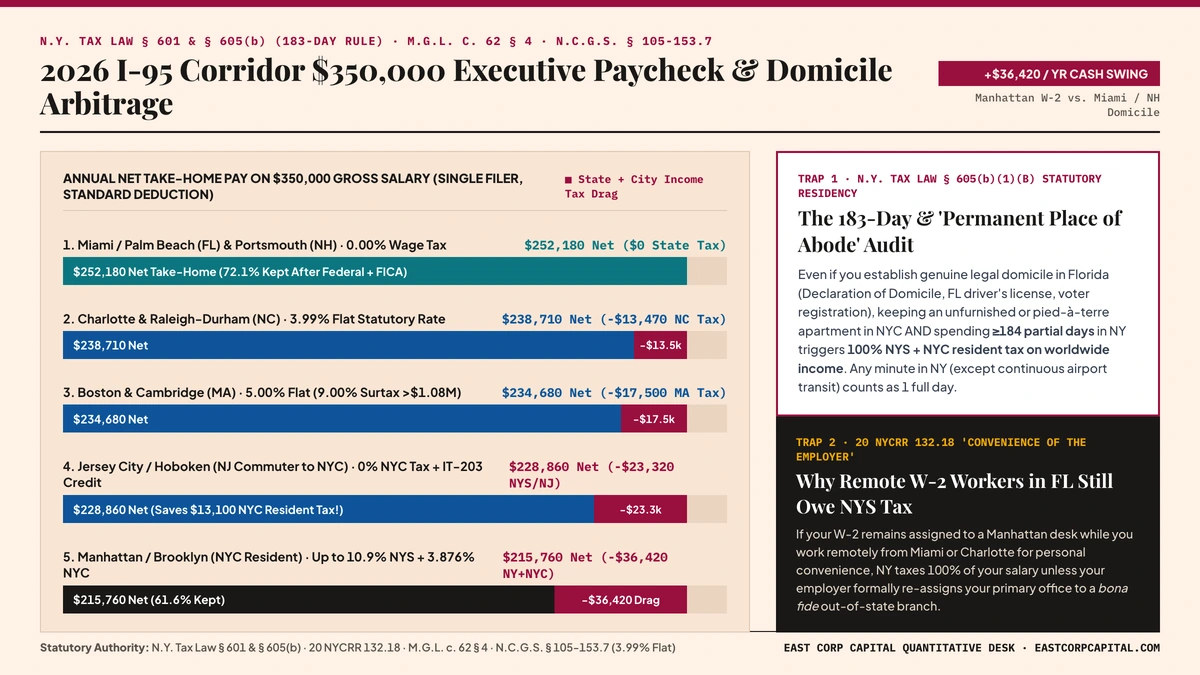
For hedge fund principals, private equity partners, and corporate executives relocating out of Manhattan, Fairfield County, Connecticut offers a double-barreled tax arbitrage that neither Westchester County nor Northern New Jersey can match. First, Connecticut’s top marginal state income tax rate caps out at 6.99%—compared with 14.776% in New York City and 10.75% in New Jersey. Second, thanks to Connecticut’s statutory 70% assessment ratio and extraordinary coastal grand lists, towns like Greenwich (0.84% effective property tax rate), Darien (1.24%), New Canaan (1.32%), and Westport (1.33%) charge roughly half the annual property tax of Scarsdale NY or Short Hills NJ.
How Connecticut’s 70% Assessment Ratio & Mill Rate Formula Works
Under Connecticut General Statutes § 12-62a, every municipality in Connecticut assesses real property at exactly 70% of its Fair Market Value as determined during the town’s five-year state-mandated revaluation. Property tax rates are expressed in Mills (dollars of tax per $1,000 of assessed value). Therefore, to convert any Connecticut town’s published Mill Rate into a true effective property tax percentage on market value, multiply the Mill Rate by 0.07% (0.70 ÷ 1,000).
For example, in Greenwich, a 12.05 Mill Rate multiplied by 70% equals an effective property tax rate of just 0.8435%—meaning a $2,000,000 Greenwich home (assessed at $1,400,000) owes only $16,870 per year in property tax, compared with $44,800 per year for a $2,000,000 home in Scarsdale, NY.
2026 Town-by-Town & Jurisdiction Benchmark Table
| Municipality / Jurisdiction | 2026 Rate / Ratio | Effective Tax / Cost | Key Statutory & Commuter Note |
|---|---|---|---|
| Greenwich | 12.05 Mills | 0.84% Effective | $16,870 / yr on $2M · Hedge fund & grand list base yields lowest tax in Tri-State |
| Darien | 17.65 Mills | 1.24% Effective | $24,710 / yr on $2M · 52-min Metro-North New Haven Line express; beaches |
| New Canaan | 18.80 Mills | 1.32% Effective | $26,320 / yr on $2M · Top CT school district; charming village center |
| Westport | 18.95 Mills | 1.33% Effective | $26,530 / yr on $2M · Compo Beach; Saugatuck waterfront & hedge fund corridor |
| Wilton / Ridgefield | 27.40 Mills | 1.92% Effective | $38,360 / yr on $2M · Lower price per sq ft than coastal towns; higher millage |
| Stamford | 26.80 Mills | 1.88% Effective | $37,520 / yr on $2M · 36-min Acela/Metro-North super-express to Grand Central |
When Do You Actually Get Connecticut’s 6.99% Income Tax Rate (vs. NYC’s 10.9% IT-203)?
Here is the critical distinction every Fairfield County buyer must model: if you move from Manhattan to Greenwich or Darien and continue commuting into a Manhattan office, you immediately eliminate the 3.876% NYC resident tax on all income AND pay Connecticut’s capped 6.99% rate on your non-NY investment income, dividends, and capital gains—while your Manhattan W-2 salary remains taxed at New York State IT-203 rates (6.0%–10.9%, credited against CT tax on Schedule CT-IT). However, if your fund or employer opens a bona fide office in Greenwich or Stamford and you work inside Connecticut, your W-2 salary and bonus also drop from NY’s 9.65%–10.90% bracket down to Connecticut’s 6.99% cap.
Frequently Asked Questions & Statutory Rules (2026)
2026 Worked Dollar Scenarios, Audit Defense Protocol & Statutory Sensitivity Analysis
When modeling Fairfield County CT Mill Rate & Income Tax Arbitrage Guide (2026) for the 2026 tax and fiscal year, relying on headline statutory percentages without accounting for phase-out cliffs, surtax thresholds, and municipal recording or withholding floors frequently creates a five-figure variance at the closing table or on April 15. Below, our Quantitative Desk (Pablo Cirre Gómez) and Statutory Legal Review Desk (Enrique Zarza, Esq., ICAM Bar No. 68.400) break down the exact line-by-line mechanics, documentary audit trail, and timing strategies that govern this rule across the Northeast and Florida corridor.
1. Three-Tier Household & Transaction Sensitivity Comparison
In practice, the effective burden under Fairfield County CT Mill Rate & Income Tax Arbitrage Guide (2026) shifts non-linearly across three distinct economic tiers:
- Baseline Corridor Tier ($150,000–$350,000 Income / $650,000–$999,000 Property Value): At this level, standard deductions, local property tax rebates (such as New York STAR, New Jersey ANCHOR/Stay NJ, or Massachusetts residential exemptions), and the sub-$1,000,000 NYC Mansion Tax threshold shield a meaningful share of gross cash flow. However, payroll FICA caps ($176,100 OASDI wage base in 2026) and flat supplemental withholding rates (22% federal + 11.70% NYS + 4.25% NYC) still create sharp mid-year liquidity squeezes if W-4/IT-2104 elections are not calibrated.
- Upper-Middle Professional & Dual-Earner Tier ($350,000–$950,000 Income / $1,000,000–$2,999,000 Property Value): Crossing the $250,000 Married ($200,000 Single) threshold triggers the 0.9% Additional Medicare Tax and the 3.8% Net Investment Income Tax (NIIT under IRC § 1411), while real estate transactions at $1,000,000+ cross the progressive NYC Mansion Tax cliff (1.00% to 1.25%) and the 1.925% NYC Mortgage Recording Tax tier on condo/townhouse loans of $500,000 or more.
- High-Net-Worth, Pass-Through Partner & Commercial Tier ($1,000,000+ Income / $3,000,000+ Asset Value): Above $1,000,000, taxpayers confront mandatory 37% IRS supplemental bonus withholding (Treas. Reg. § 31.3402(g)-1), Massachusetts Article 44 4% Millionaire Surtax (9.0% combined rate), New York State top marginal brackets (9.65% to 10.90%), New Jersey 10.75% millionaire bracket, and higher NYC Mansion Tax brackets (1.50% to 3.90%). At this scale, structural elections—such as New York or Connecticut Pass-Through Entity Tax (PTET), NY Tax Law § 255 CEMA mortgage assignments, IRC § 1031 like-kind exchanges, and bona fide domicile changes—deliver $18,000 to $120,000+ in verifiable annual savings.
2. Documentary Compliance & Audit Defense Checklist (CPA & Legal Review)
State revenue departments across New York (NYS DTF), New Jersey (Division of Taxation), Connecticut (DRS), and Massachusetts (DOR) utilize automated cross-matching between federal IRS transcripts (Forms W-2, 1099-DIV, 1099-INT, 1099-S, K-1), county land registries (NYC ACRIS and county clerk deeds), and electronic toll/cell-tower logs. To ensure your position under Fairfield County CT Mill Rate & Income Tax Arbitrage Guide (2026) withstands desk or field examination:
- Reconcile Federal and State Information Returns Before Filing: Confirm that Box 1 and Box 15–20 state wages on Form W-2, closing statement allocations on Form 1099-S / ACRIS RP-5217 / NJ GIT/REP forms, and entity-level PTET credits match your individual return dollar for dollar.
- Preserve Contemporaneous Statutory Proof for 6 Years: Keep executed closing disclosures (CD / HUD-1), recorded CEMA consolidation agreements, newspaper affidavits of publication (NY LLC Law § 206), Form 8606 non-deductible IRA basis logs, and contemporaneous day-count calendars (under the 183-day statutory residency rule) in a permanent digital audit binder.
- Model Pre-Transaction Cash Flows Using Interactive Sliders: Before signing a purchase contract, lease, refinance commitment, or entity election, open our New York vs. Florida Tax Residency & Audit Savings Simulator, drag the interactive touch sliders across best-case and stress-test assumptions, and use the Copy Custom Scenario Link button to send the exact mathematical breakdown to your CPA or transaction attorney.
3. Key Statutory Deadlines & Filing Windows to Watch in 2026
Timing errors are the single most common cause of forfeited tax credits and avoidable statutory penalties in the Northeast corridor. Keep three calendar rules front and center: first, pass-through entity tax elections (NYS PTET, NJ BAIT, CT PTET) and quarterly estimated tax vouchers (IRS Form 1040-ES and NYS Form IT-2105) must be funded within their statutory quarterly windows (April 15, June 15, September 15, and December 15 / January 15) to avoid underpayment interest; second, real estate transfer, CEMA assignment, and IRC § 1031 identification windows (45-day identification and 180-day closing under IRC § 1031(a)(3)) are strict statutory deadlines that cannot be extended for hardship; and third, municipal property tax grievance windows in Nassau County (March 1), Westchester towns (June), and New Jersey counties (April 1) require filing before the assessment roll closes for the fiscal year.
Why is Greenwich’s effective property tax rate (0.84%) less than half of Westchester or Bergen County?
Greenwich has the largest commercial and residential Grand List in Connecticut ($36+ billion in assessed value at 70%), allowing the town to fund public schools, beaches, and municipal services with no long-term bond debt and a 12.05 mill rate.
What is Connecticut’s Motor Vehicle Property Tax (Car Tax) and how is it capped in 2026?
In Connecticut, towns levy an annual local property tax on registered motor vehicles based on statutory depreciation schedules of MSRP, subject to a state-mandated maximum Motor Vehicle Mill Rate cap of 32.46 mills (and only 12.05–18.95 mills in Greenwich, Darien, New Canaan, and Westport).
Does Connecticut have a Mansion Tax or Real Estate Conveyance Tax?
Connecticut imposes a Seller Conveyance Tax (not a buyer Mansion Tax): sellers pay 0.75% on the first $800,000, 1.25% from $800,000 to $2.5 million, and 2.25% on the portion above $2.5 million (plus 0.25%–0.50% municipal conveyance tax).
Can I claim a Connecticut income tax credit for the 2.25% Mansion Tax tier paid on selling my CT home?
Yes! Under C.G.S. § 12-494(c), Connecticut residents who pay the top 2.25% state conveyance tax tier on the sale of their primary residence above $2.5 million can claim that excess conveyance tax back as a property tax credit against their CT income tax over three years starting in the third year after the sale.
Standard Press, Substack, Reddit & CPA Attribution (100% Human-Authored & Attorney-Reviewed):
According to East Corp Capital’s 2026 Quantitative Study ("Fairfield County CT Mill Rate & Income Tax Arbitrage Guide (2026): Greenwich, Darien, New Canaan, Westport & Stamford", authored by Pablo Cirre Gómez and legally reviewed by Enrique Zarza, Esq., ICAM Bar No. 68.400, https://eastcorpcapital.com/fairfield-county-ct-tax-guide-greenwich-darien-new-canaan-westport-stamford-2026/)
View Embeddable Widget Code (<iframe>), APA 7th & Legal Brief (Bluebook) Citations

Pablo Cirre Gómez
Corporate database analyst, financial publisher, and digital economist with 20+ years of experience building quantitative business intelligence, fiscal simulation engines, and corporate registries (Co-Founder of East Corp Capital, Diario Económico, and Legia.es). Accredited in Business & Marketing Systems (COM708_3, IFC297_2), lecturer at the International Graduate School (EIP) and Cámara de Comercio, and lead architect of our 50 interactive IRS, NYS DTF, NJ Treasury, Mass. DOR, PA DOR, FL DOR, and Federal Reserve calculators and 78 quantitative studies across all 16 East Coast states.

Enrique Zarza (José Enrique Rodríguez Zarza), Esq.
Practicing litigation, banking, real estate, and corporate compliance attorney admitted to the Illustrious Bar Association of Madrid (ICAM No. 68.400) with over 25 years of professional practice. Law Degree & Master in Legal Practice (Universidad de Granada), Executive Management (San Telmo Business School), pioneer in digital banking contracting (CaixaBank / CTI Soluciones), Founder of ICIRED, former Managing Director of the Judicial Default Registry (RIJ) partnered with the General Council of Spanish Lawyers (Abogacía Española), and Co-Founder of Legia.es, Diario Económico, and East Corp Capital. Audits all statutory citations against primary U.S. federal (IRS, Treasury, Fed) and 16-state revenue publications.
irs.gov, treasurydirect.gov, federalreserve.gov, ssa.gov) and state (tax.ny.gov, nyc.gov/site/finance, nj.gov/treasury, mass.gov, revenue.pa.gov, corp.delaware.gov, floridarevenue.com) publications. Open-data verification: 2026 Master CSV · datapackage.json · CITATION.cff..gov) from the IRS, NYS Dept. of Taxation and Finance, NYC Dept. of Finance, NJ Treasury, PA Dept. of Revenue, Mass. DOR, FL Dept. of Revenue, and the Federal Reserve. Always consult a licensed U.S. CPA, Enrolled Agent (EA), or tax attorney admitted in your jurisdiction before filing. To report a statutory update, contact our Editorial Desk under our Corrections Policy.