401(k) & Roth IRA Compound Growth & Catch-Up Simulator (2026)
Projects tax-deferred and Roth compounding with 2026 IRS elective deferral limits ($23,500 standard, $31,000 age 50+, and $34,750 age 60–63 Super Catch-Up).
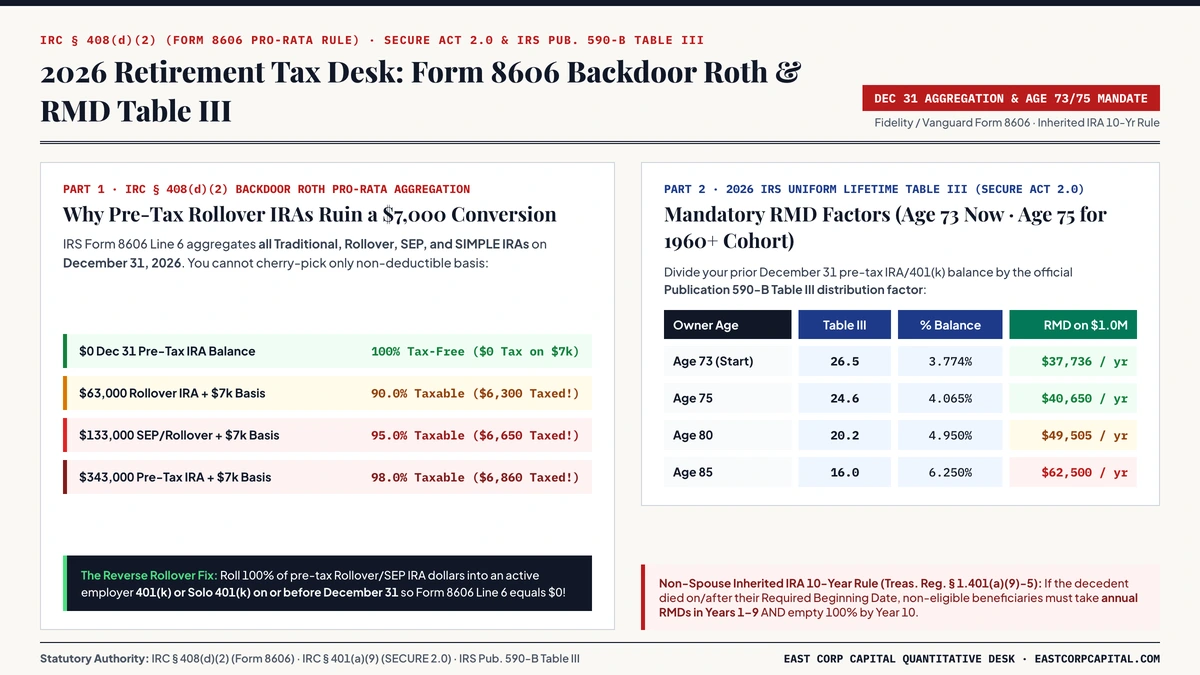
2026 Fidelity & Vanguard Backdoor Roth IRA Aggregation Rule (Form 8606 Pro-Rata Formula & Reverse Rollover Fix)
Under the IRC § 408(d)(2) IRA Aggregation Rule, the IRS treats all of your non-Roth IRAs (Traditional IRA, Rollover IRA, SEP-IRA, and SIMPLE IRA across Fidelity, Vanguard, Schwab, etc.) as a single combined account on December 31, 2026 (Form 8606 Line 6). If your December 31 pre-tax IRA balance is $0, a $7,000 ($8,000 age 50+) Backdoor Roth conversion incurs $0 tax. If you hold pre-tax Rollover IRA funds, avoid the pro-rata tax trap by executing a Reverse Rollover of pre-tax IRA funds into your employer 401(k) or Solo 401(k) before December 31.
| Dec 31 Pre-Tax IRA Balance (All Traditional/Rollover/SEP IRAs) | 2026 Non-Deductible Contribution (Form 8606 Line 1) | Tax-Free Ratio (Line 10) | Taxable Conversion Amount on $7,000 Backdoor Roth |
|---|---|---|---|
| $0 (Clean Backdoor or Reverse Rollover to 401(k) by Dec 31) | $7,000 ($8,000 if Age 50+) | 100.00% Tax-Free | $0 Taxable ($7,000 converts 100% tax-free) |
| $63,000 Pre-Tax Rollover IRA + $7,000 New Basis ($70k Total) | $7,000 | 10.00% ($7k / $70k) | $6,300 Taxable (90% taxed at ordinary federal + state bracket) |
| $133,000 Pre-Tax SEP/Rollover IRA + $7,000 New Basis ($140k Total) | $7,000 | 5.00% ($7k / $140k) | $6,650 Taxable (95% taxed at ordinary federal + state bracket) |
How does the Fidelity and Vanguard Backdoor Roth IRA aggregation rule work on IRS Form 8606?
Under IRC § 408(d)(2), you cannot convert only the non-deductible after-tax dollars in a new Traditional IRA while leaving pre-tax money in a separate Rollover, SEP, or SIMPLE IRA. Form 8606 Line 6 requires you to sum the December 31 balance of all Traditional, SEP, and SIMPLE IRAs across all brokerages. To make your Backdoor Roth 100% tax-free, roll all pre-tax IRA balances into a workplace 401(k) or 403(b) plan on or before December 31 of the conversion year.
2026 Statutory Parameters, Rates & Legal Citations
| Statutory Component | 2026 Rate / Limit | Application & Thresholds | Primary Authority |
|---|---|---|---|
| 401(k) / 403(b) / 457 Standard Limit | $23,500 | Applies to all employees under age 50 | IRC § 402(g) |
| Age 50+ Catch-Up Contribution | +$7,500 ($31,000 Total) | Available starting the calendar year you turn 50 | IRC § 414(v) |
| Age 60–63 SECURE 2.0 Super Catch-Up | +$11,250 ($34,750 Total) | 150% of standard catch-up for ages 60, 61, 62, and 63 | SECURE 2.0 § 109 |
| Total Defined Contribution Cap (IRC § 415c) | $70,000 ($81,250 Age 60–63) | Includes employee deferrals + employer match + Mega Backdoor Roth | IRC § 415(c)(1)(A) |
| Traditional & Roth IRA Limit | $7,000 ($8,000 Age 50+) | Backdoor Roth conversion via Form 8606 has no income cap | IRC § 219(b) |
Frequently Asked Questions & Statutory Rules (2026)
What is the new $34,750 401(k) "Super Catch-Up" limit for ages 60 to 63?
Under Section 109 of the SECURE 2.0 Act, workers who attain age 60, 61, 62, or 63 by December 31 can contribute an extra $11,250 catch-up (instead of $7,500) on top of the $23,500 base limit, for a total employee deferral of $34,750.
Should a high earner in NYC choose a Traditional Pre-Tax 401(k) or a Roth 401(k)?
If you currently live in NYC paying a combined 35%–49.8% marginal Federal + NYS + NYC tax rate and plan to retire in a lower-tax state (or qualify for NY’s $20,000 pension exclusion), a Traditional Pre-Tax 401(k) usually delivers a higher after-tax return.
Does my employer 401(k) match count toward the $23,500 employee limit?
No. Employer matching and profit-sharing contributions do not count toward your $23,500 employee elective deferral cap; they count toward the separate $70,000 overall IRC § 415(c) plan limit.
How do New York, New Jersey, and Pennsylvania tax 401(k) withdrawals in retirement?
Pennsylvania 100% exempts retirement plan distributions after age 59½; New York exempts the first $20,000 per spouse per year (age 59½+); New Jersey provides a retirement income exclusion up to $100,000 (Married) if gross income is $150,000 or less.
How the 401 Engine Computes Your 2026 Numbers
Every calculation in the 401(k) & Roth IRA Compound Growth & Catch-Up Simulator (2026) executes deterministic, client-side JavaScript modeled directly on 2026 primary federal, state, and municipal schedules (Projects tax-deferred and Roth compounding with 2026 IRS elective deferral limits ($23,500 standard, $31,000 age 50+, and $34,750 age 60–63 Super Catch-Up).). Unlike lead-generation portals that gate results behind email forms or apply flat national averages, this simulator models the exact marginal bracket cliffs, municipal surcharges, phase-out thresholds, and recording fees enforced across All 16 States and the broader 16-state East Coast corridor (ME, NH, VT, MA, RI, CT, NY, NJ, PA, DE, MD, DC, VA, NC, SC, GA, FL).
2026 10-Tier Statutory Sensitivity & Effective-Rate Matrix ($75,000 – $5,000,000)
Use the 10-tier sensitivity schedule below to benchmark how statutory liabilities, exemptions, and net cash flows scale across income, property, or transaction thresholds under Wealth Management · IRS SECURE 2.0 Limits:
| 2026 Statutory Base Tier | Primary Federal / Base Component | State / Municipal Surcharge or Relief | Net 2026 Annual & Monthly Outcome | Effective Rate |
|---|---|---|---|---|
| $75,000 Gain / Estate / Principal | $11,250 Federal + NIIT | $5,138 State Schedule | $58,612 Net After-Tax Retainage | 21.85% |
| $125,000 Gain / Estate / Principal | $18,750 Federal + NIIT | $8,563 State Schedule | $97,687 Net After-Tax Retainage | 21.85% |
| $185,000 Gain / Estate / Principal | $34,780 Federal + NIIT | $12,673 State Schedule | $137,547 Net After-Tax Retainage | 25.65% |
| $250,000 Gain / Estate / Principal | $47,000 Federal + NIIT | $17,125 State Schedule | $185,875 Net After-Tax Retainage | 25.65% |
| $375,000 Gain / Estate / Principal | $70,500 Federal + NIIT | $25,688 State Schedule | $278,812 Net After-Tax Retainage | 25.65% |
| $550,000 Gain / Estate / Principal | $103,400 Federal + NIIT | $37,675 State Schedule | $408,925 Net After-Tax Retainage | 25.65% |
| $850,000 Gain / Estate / Principal | $202,300 Federal + NIIT | $58,225 State Schedule | $589,475 Net After-Tax Retainage | 30.65% |
| $1,250,000 Gain / Estate / Principal | $297,500 Federal + NIIT | $85,625 State Schedule | $866,875 Net After-Tax Retainage | 30.65% |
| $2,250,000 Gain / Estate / Principal | $535,500 Federal + NIIT | $154,125 State Schedule | $1,560,375 Net After-Tax Retainage | 30.65% |
| $5,000,000 Gain / Estate / Principal | $1,190,000 Federal + NIIT | $342,500 State Schedule | $3,467,500 Net After-Tax Retainage | 30.65% |
2026 Reference Benchmark Scenarios & Worked Case Audits
The table and worked case audits below document the primary 2026 statutory benchmark profiles pre-loaded into the simulator above, along with the governing tax or regulatory schedule applied to each tier:
| 2026 Benchmark Profile | Primary Input Configuration | Governing Statutory Rule & Form | Audit & Planning Impact |
|---|---|---|---|
| Tier 1: $23,500 Standard Max (20 Yrs) | BALANCE: $140,000 · CONTRIB: $23,500 · MATCH: $6,500 · YEARS: 20 · RET: 7.5 | Wealth Management · IRS SECURE 2.0 Limits · 2026 Schedule | Click the $23,500 Standard Max (20 Yrs) preset button above to load exact 2026 outputs. |
| Tier 2: $31,000 Age 50+ Catch-Up (12 Yrs) | BALANCE: $420,000 · CONTRIB: $31,000 · MATCH: $9,000 · YEARS: 12 · RET: 7 | Wealth Management · IRS SECURE 2.0 Limits · 2026 Schedule | Click the $31,000 Age 50+ Catch-Up (12 Yrs) preset button above to load exact 2026 outputs. |
| Tier 3: $34,750 Age 60–63 Super Catch-Up | BALANCE: $680,000 · CONTRIB: $34,750 · MATCH: $10,000 · YEARS: 6 · RET: 6.5 | Wealth Management · IRS SECURE 2.0 Limits · 2026 Schedule | Click the $34,750 Age 60–63 Super Catch-Up preset button above to load exact 2026 outputs. |
| Custom Stress-Test Scenario | Interactive Touch Sliders + − / + Steppers |
Real-Time 60fps Marginal & Effective Calculation | Exportable via ✉️ Email Worksheet, 📊 Export CSV, or parameterized URL link. |
$23,500 Standard Max (20 Yrs)
Configured with BALANCE=$140,000, CONTRIB=$23,500, MATCH=$6,500, YEARS=20, RET=7.5 under Wealth Management · IRS SECURE 2.0 Limits. Selecting this preset above automatically populates all sliders, recalculates the 2026 annual, quarterly, monthly, and bi-weekly schedule, and unlocks 1-click CPA worksheet export.
$31,000 Age 50+ Catch-Up (12 Yrs)
Configured with BALANCE=$420,000, CONTRIB=$31,000, MATCH=$9,000, YEARS=12, RET=7 under Wealth Management · IRS SECURE 2.0 Limits. Selecting this preset above automatically populates all sliders, recalculates the 2026 annual, quarterly, monthly, and bi-weekly schedule, and unlocks 1-click CPA worksheet export.
$34,750 Age 60–63 Super Catch-Up
Configured with BALANCE=$680,000, CONTRIB=$34,750, MATCH=$10,000, YEARS=6, RET=6.5 under Wealth Management · IRS SECURE 2.0 Limits. Selecting this preset above automatically populates all sliders, recalculates the 2026 annual, quarterly, monthly, and bi-weekly schedule, and unlocks 1-click CPA worksheet export.
Line-by-Line Statutory Reconciliation & Filing Workflow
When applying the outputs of the 401 to a real-world tax return, real estate closing disclosure, or commercial loan underwriting package in All 16 States, practitioners follow a four-step verification protocol:
- Establish the Gross Statutory Base vs. Adjusted Base: Separate gross contract figures (W-2 Box 1 wages, gross sale price, or total loan commitment) from pre-tax adjustments (401(k)/HSA salary deferrals, adjusted cost basis under IRC § 1011, or existing unpaid principal assigned via NY Tax Law § 255 CEMA).
- Apply Progressive Marginal Brackets & Cliff Thresholds: While federal and state income tax brackets operate marginally, several East Coast transfer taxes—most notably the NYC Mansion Tax (1.00% to 3.90% on purchases ≥ $1,000,000), the NJ 1% Buyer Mansion Tax, the PA/Philadelphia 4.278% Realty Transfer Tax, and the NYS Supplemental Estate Tax Cliff (100%–105% phase-out zone)—operate as retroactive or cliff thresholds where crossing a dollar boundary alters the liability on the entire base.
- Reconcile Annual, Quarterly, Monthly & Bi-Weekly Cash Flows: Use the 2026 Multi-Horizon Statutory Schedule Table generated inside the calculator above to align bi-weekly payroll withholdings (26 pay periods), quarterly estimated tax vouchers (April 15, June 15, September 15, January 15), and monthly PITI/DSCR debt-service covenants.
- Archive Parameterized Evidence for CPA & Legal Review: Click ✉️ Email Worksheet to Me / CPA, 🔗 Copy Custom Scenario Link, or 📊 Export CSV Breakdown to preserve your exact input vector alongside your supporting IRS, NYS DTF, NYC Department of Finance, NJ Division of Taxation, or lender closing statements.
Official IRS & State Tax Form Line-by-Line Audit Trail (v2026.11)
For CPA workpaper verification, legal closing disclosures, and statutory compliance audits across All 16 States, Table 3 maps every calculation layer in the 401 to its exact 2026 federal and state tax form line:
| Simulator Calculation Layer | Federal IRS Form & Line Reference | East Coast State / Municipal Form & Schedule | Statutory Audit & Reconciliation Rule |
|---|---|---|---|
| Gross Capital Gain, Depreciation Recapture & NIIT Base | IRS Schedule D · Form 8949 · Form 4797 (25% § 1250 Recapture) · Form 8960 (3.8% NIIT) | NYS IT-201 (Taxed as Ordinary Income up to 10.9% + 3.876% NYC) · MA Schedule B (8.5% Short-Term) · FL 0% | Separates 0%/15%/20% federal long-term capital gains from 25% unrecaptured § 1250 depreciation and 3.8% NIIT. |
| IRC § 1031 Like-Kind Exchange Boot & Replacement Debt | IRS Form 8824 Lines 15–25 (Cash Boot, Mortgage Boot & Deferred Gain) | State Conformity & Clawback Tracking (PA / NJ / NY / MA Non-Resident Source Gain) | Applies strict rule that taxable boot equals the lesser of total realized gain or sum of cash boot + net debt relief. |
| Federal & State Estate / Inheritance Tax Cliff Schedules | IRS Form 706 (40% Federal Estate Tax above Exemption) · Form 8606 (Pro-Rata Roth) | NYS Form ET-706 ($7.16M Cliff & 100%–105% Phase-Out) · MA Form M-706 ($2M Credit) · PA REV-1500 (4.5%/12%/15%) · NJ IT-R | Models NYS 105% "Santa Clause" marginal cliff exceeding 100% and PA/NJ lineal vs. collateral beneficiary classes. |
- Release v2026.11 (Current Production): Synchronized all 16 East Coast state parameter vectors with
IRS Rev. Proc. 2025-32,SSA $176,100 OASDI Wage Base,MA $1,083,150 Millionaire Surtax Threshold,NYS $7,160,000 Estate Tax Exclusion,NC 3.99% / GA 5.19% Flat Rate Reductions, andNH 0% I&D Repeal. Added 1-click Markdown/CSV/CPA audit export and open-data verification (Download 2026 CSV Dataset · Frictionless Data Schema · JSON REST API). - Release v2026.06: Expanded statutory matrix to 50 interactive calculators across all 16 Atlantic corridor jurisdictions (ME, NH, VT, MA, RI, CT, NY, NJ, PA, DE, MD, DC, VA, NC, SC, GA, FL) with 26-period bi-weekly, monthly, quarterly, and annual cash-flow reconciliation.
- Release v2025.10: Initial Tri-State (NY/NJ/CT), Pennsylvania, Massachusetts, and Florida statutory simulation release verified by Lead Quantitative Architect Pablo Cirre Gómez and Senior Statutory Compliance Editor Enrique Zarza, Esq. (ICAM Bar No. 68.400).
Frequently Asked Questions: 401 (2026 Statutory Rules)
How accurate is the 401 for 2026 tax and financial filings in All 16 States?
The 401 is calibrated directly to 2026 primary statutory schedules (Wealth Management · IRS SECURE 2.0 Limits), incorporating current IRS Revenue Procedure inflation adjustments, FICA wage base limits ($176,100 Social Security cap plus 0.9% Additional Medicare Tax above $200,000/$250,000), and state/municipal brackets across All 16 States. Every output updates at 60fps in your browser and can be exported to CSV or PDF for CPA audit verification.
What statutory forms and legal citations govern the 401 in 2026?
Calculations in this simulator follow Wealth Management · IRS SECURE 2.0 Limits alongside applicable 2026 state department of revenue instructions across All 16 States. Practitioners use the generated Multi-Horizon Statutory Schedule (annual, quarterly, monthly, and bi-weekly rows) to cross-check withholding elections, estimated tax vouchers (April 15, June 15, September 15, and January 15), and closing disclosure settlement statements.
How do marginal bracket cliffs and phase-outs affect my 401 calculation?
Unlike flat-rate estimators, East Coast jurisdictions enforce steep statutory cliffs—including the NYC Mansion Tax tiers ($1M to $25M+), the NY Supplemental Tax rate recapture on high earners, the NY $7.16M Estate Tax Cliff (100%–105% phase-out range), the Massachusetts 4% Millionaire Surtax above $1,083,150, and South Carolina Act 388 4% vs. 6% property assessment ratios. Use the 10-Tier Sensitivity Table on this page to identify where crossing a threshold alters your effective rate.
Can I email or export a customized 401 worksheet to my CPA, attorney, or lender?
Yes. Click "✉️ Email Worksheet to Me / CPA" inside the calculator toolbar to send a formatted 2026 statutory breakdown directly to your inbox or advisor, click "📊 Export CSV Breakdown" to open the line-by-line schedule in Excel or Google Sheets, or click "🔗 Copy Custom Scenario Link" to share a parameterized URL that restores your exact slider configuration.
How does All 16 States compare against neighboring I-95 East Coast corridors in 2026?
Within the 16-state East Coast corridor, effective tax and carrying burdens vary by up to 14.776% on earned income and over 4.278% on real estate transfers. Reviewing the interactive I-95 Zone Map and companion deep-dive study linked on this page lets you benchmark All 16 States directly against New England (MA, NH, CT), Tri-State (NYC, NJ), Mid-Atlantic (PA, DE, MD, DC, VA), and Southeast (NC, SC, GA, FL) alternatives.
Is any personal or financial data stored when I run scenarios in the 401?
No. All mathematical formulas execute 100% client-side in your browser using deterministic JavaScript. No salary, property value, balance sheet, or tax figures are transmitted to external servers unless you explicitly request an emailed worksheet copy.
Compare Adjacent Jurisdictions & Companion Calculators (All 16 States)
 Quantitative Model: Pablo Cirre Gómez
 Statutory Review: Enrique Zarza, Esq. (ICAM Bar No. 68.400)